 I'm working on a project (hopefully to be completed this summer) that needed a longer, less rigid camera cable for my Pi camera board. I thought I would document this part of the project separately since it might be useful to others.
Showing posts with label cameras. Show all posts
Showing posts with label cameras. Show all posts
Friday, May 8, 2015
Raspberry Pi Camera Extension Cable
I'm working on a project (hopefully to be completed this summer) that needed a longer, less rigid camera cable for my Pi camera board. I thought I would document this part of the project separately since it might be useful to others.
Monday, October 6, 2014
Camera Geometries for SfM - UPDATE
This is a quick update for my original camera geometry post.
Based on work by Mike James and Stuart Robson (Link) and some of my own research it has become apparent that strictly parallel camera geometries produce some interesting distortions in some SFM reconstructions. The parallel nature can cause systematic distortions in final point clouds, DEMs, etc...
Therefore, it is good practice to not limit yourself to one specific geometry. Convergent geometries seem to work the best in most situations. A variety of camera heights also seem to improve things and helps add to the convergent geometry. My suggestion is to play around with different geometries in an area that's analogous to your study area to get a feel for what type of pattern will work best and be efficient.
Based on work by Mike James and Stuart Robson (Link) and some of my own research it has become apparent that strictly parallel camera geometries produce some interesting distortions in some SFM reconstructions. The parallel nature can cause systematic distortions in final point clouds, DEMs, etc...
Therefore, it is good practice to not limit yourself to one specific geometry. Convergent geometries seem to work the best in most situations. A variety of camera heights also seem to improve things and helps add to the convergent geometry. My suggestion is to play around with different geometries in an area that's analogous to your study area to get a feel for what type of pattern will work best and be efficient.
Thursday, February 6, 2014
Camera geometries for Structure-from-Motion mapping

Camera geometry, the way photographs overlap, is an important factor in successful mapping when using Structure-from-Motion (SfM). There are several main geometries that photosets fall into: divergent, convergent, parallel, and whether the camera is pointed at a nadir or oblique angles. The type of geometry you use is dependent on the research question and there is always going to be some natural variation in a photoset but you should attempt to keep a consistent overall geometry in the scene. These are simply guidelines, one of the beautiful things about SfM is that is can be forgiving, so if you do not take perfectly aligned photos your 3D model will not be lost. Also, I cannot stress the important of practice. Before you head out for a full field campaign find an analog to your study site and practice taking photographs using the different camera geometry guidelines. This will help you plan for the field and also let you experiment with the processing workflow and familiarize yourself with how the software behaves.
Tuesday, January 14, 2014
Wired CHDK Trigger for Pole Photography
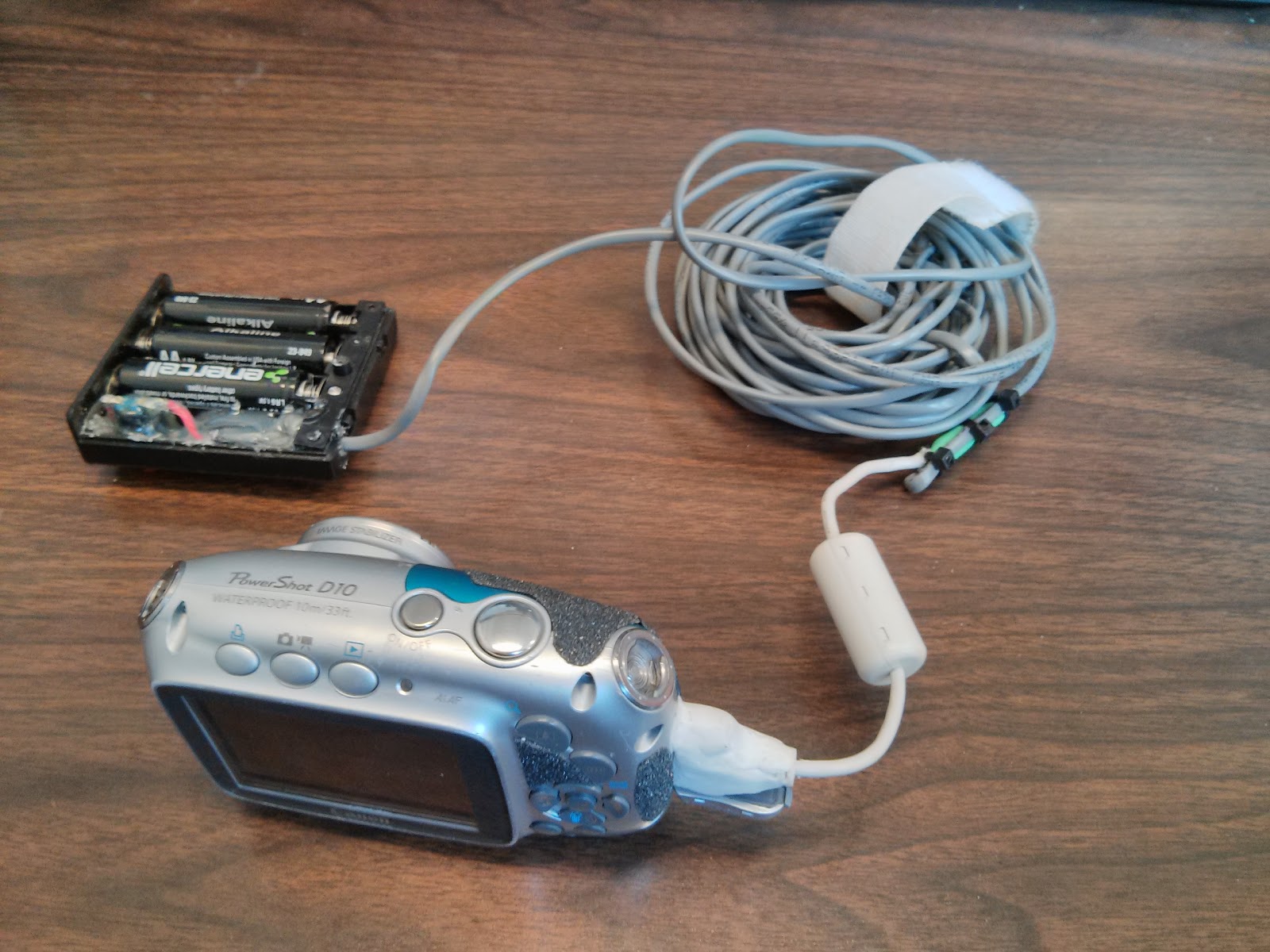 As some of you may know, I use occasionally use pole photography for my research. Getting the camera on the pole is the easy part (Pole Camera), the hard part is getting it to take pictures while it's up there.
I use almost entirely Canon cameras and CHDK is such a wonderful add-on to the smaller cameras I use. One key thing CHDK allows you to do is use the USB port on the camera to trigger the camera. This post is a rehash of the basic remote trigger that CHDK has on their site (http://chdk.wikia.com/wiki/USB_Remote), but I thought I'd post my design if you're interested in building your own.
Friday, October 11, 2013
Cameras for SfM

Sunday, September 29, 2013
Helicopter Aerial Photography
Just finished collecting data for the last part of my dissertation (Hooray!!!). Just thought I'd share some of the results. The photos were processed with Agisoft Photoscan Pro and the orthophotos ended up with a resolution of 5cm (which is exactly what I wanted). Great first results and special thanks to Mark Croghan at the Bureau of Reclamation for the funding and Troy Woydziak at Baker Aircraft for his great piloting.

Wednesday, June 27, 2012
Helilite Picavet
 For our Helikite (http://www.allsopp.co.uk/) the stock camera mount wasn't doing the trick for what we needed. We decided to build a picavet to hang underneath. With some direction from Charles Benton's website (http://arch.ced.berkeley.edu/kap/equip/picavet.html) we constructed the cradle from some 1/4" basswood, a few small screw eyes, and a bent metal coat hanger to attach the camera to the cross. The whole thing was attached to the balloon with two Prusik knot loops (the pink string on the bottom photo).
Tuesday, June 26, 2012
Pole Camera
 Below are the instructions for constructing a basic pole camera with
off the shelf parts. You’ll need something to trigger the camera while
it’s up in the air. I use the remote that came with my DSLR or an IR
intervelometer, you could use a wired trigger if you can make one with a
long enough cord.All of the materials for this project can be found at most home improvement stores.
Below are the instructions for constructing a basic pole camera with
off the shelf parts. You’ll need something to trigger the camera while
it’s up in the air. I use the remote that came with my DSLR or an IR
intervelometer, you could use a wired trigger if you can make one with a
long enough cord.All of the materials for this project can be found at most home improvement stores.
Subscribe to:
Posts (Atom)